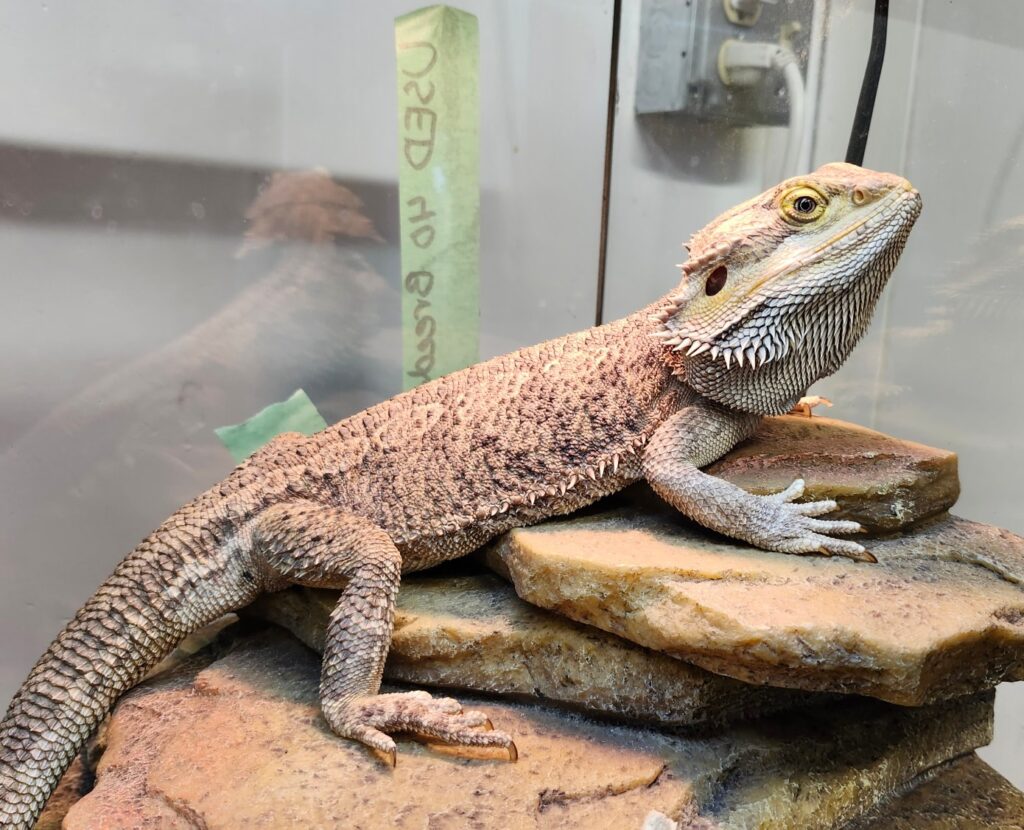
Bearded Dragon Guide 12/17/2025
With the holiday season coming, we feel it’s a good time to make a post on:
“What do you need to own a Bearded Dragon? And what are some tips?”
1. You need a Desert 10.0 UVB light, which needs to be replaced every 1 – 1.5 years MINIMUM. You can get a coil UVB bulb and be fine, but the tube UVB bulbs are better as they put off a more consistent spectrum.
2. You need a basking light hot enough to reach between 95-105 degrees where your beardie sits, but if your beardie is not basking under the light, we find either the basking surface is getting too hot, or some beardies like specific heat conditions that are slightly cooler. Example 93 degrees. Don’t get a basking rock. Not only can they start a house fire, but they can also burn your reptile.
3. DO NOT GET SAND. Yes, Bearded Dragons live on sand in the wild, but the sand in Australia is not the same as what stores carry, as they live on almost a clay-like substrate. Pet store sand is fine-grained, not diggable, and has an increased risk of impaction. Get Reptisoil for them instead, as the dirt is easier to pass, encourages natural digging behaviors, and helps the humidity in the tank. Baby beardies shouldn’t get substrate, as they can and will eat it, which blocks their digestion, ultimately killing them.
4. Adults should be in a BARE MINIMUM of a 40-gallon Breeder, no less. Any less and they experience muscle deterioration. Babies can be housed in a 20-gallon tank so that the humidity and heat can be monitored closely, but they will need upgrades to bigger tanks as they grow.
5. Food, one of the most talked-about topics. Babies can eat 10-30 crickets a feeding, whereas adults can eat 20-30 in a feeding. We feed ours 3-4 times a week. It’s important to keep in mind they will not eat if they are not hungry, and adult bearded dragons are prone to obesity if you either let them be picky or don’t give them options. Dubia roaches are healthier than crickets. Crickets are healthy and can be fed daily. Hornworms are more of a treat, but they really help with hydration and protein. Waxworms are not to be fed regularly as they are SUPER fatty, but a nice treat. Super worms are a good filler, but always better than mealworms, and mealworms kind of suck for beardies. PLEASE always feed baby dragons in a **separate** container, as they cannot always chase the food in their cage, and will give up/slowly starve. We recommend visiting http://www.beautifuldragons.com/Nutrition.html for information on vegetables, greens, and vitamins. We personally recommend dusting crickets once a week with calcium and once a week with vitamins.
6. If your Bearded Dragon ever gets sick, the first thing any vet will ask is what the heat and humidity are at, so it’s important to get a gauge to read both of those if you have any issues.
7. Most Bearded Dragons like to sleep in hides, making it extremely important they not only have one hide for their cool half of the tank, but also the warm. A hide should be large enough to cover the whole dragon (Although some will still stick half their bodies out). This provides them with a place where they can feel safe at night.
If you are looking to get a bearded dragon this holiday season, this is the place. We have multiple surrendered adults looking for another home, and babies ready to go. Let’s get you started with the right resources.